A Maryland tradition, layer by layer
Some foods are just food. And some foods are memory, identity, and place all folded into one.
Smith Island Cake is the second kind.
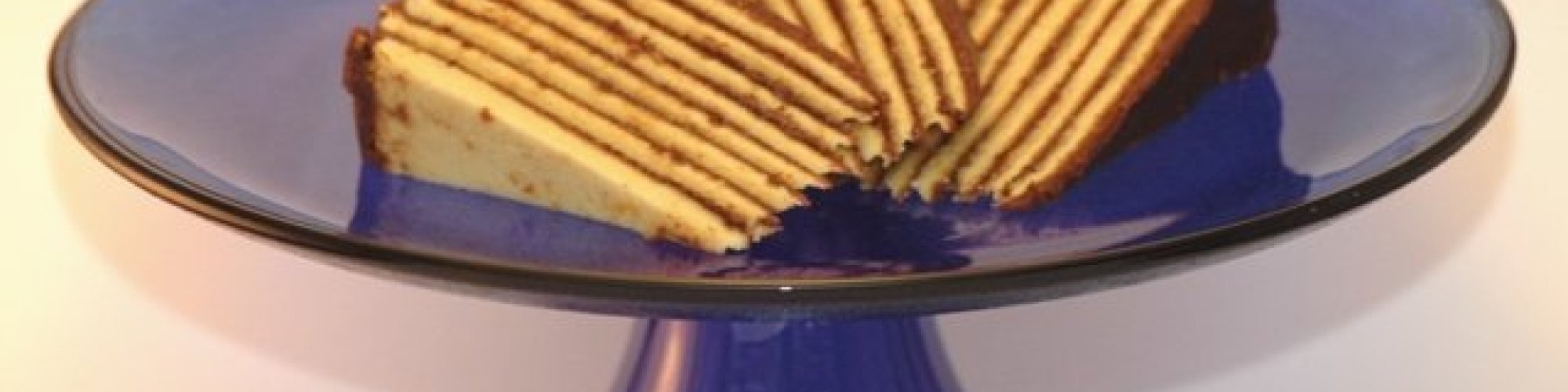
Maryland's official state dessert didn't come from a bakery or a food trend, though it is so beloved today that it inspires its own statewide Smith Island Cake Trail. It came from generations of women baking thin layers one at a time in tin ovens over open flames on a small island in the middle of the Chesapeake Bay. It came from Christmas cakes and dredge boats and Halloween socials and a quiet competition among neighbors to see who could add one more layer than the woman next door.
It came from people like Mary Ada Marshall and Janice Marshall, lifetime Smith Island residents who grew up watching their grandmothers mix eggs, butter and sugar by hand and let small fingers taste the batter off the end of a spoon.
Their stories, written in their own words, are below.
This is where the cake comes from. And this is why it tastes the way it does. The origin of all those thin layers? A Halloween cake walk in the early 1970s. Mary Ada Marshall was there.
Letter from Mary Ada Marshall | October 16, 2022 | Lifetime resident of Smith Island
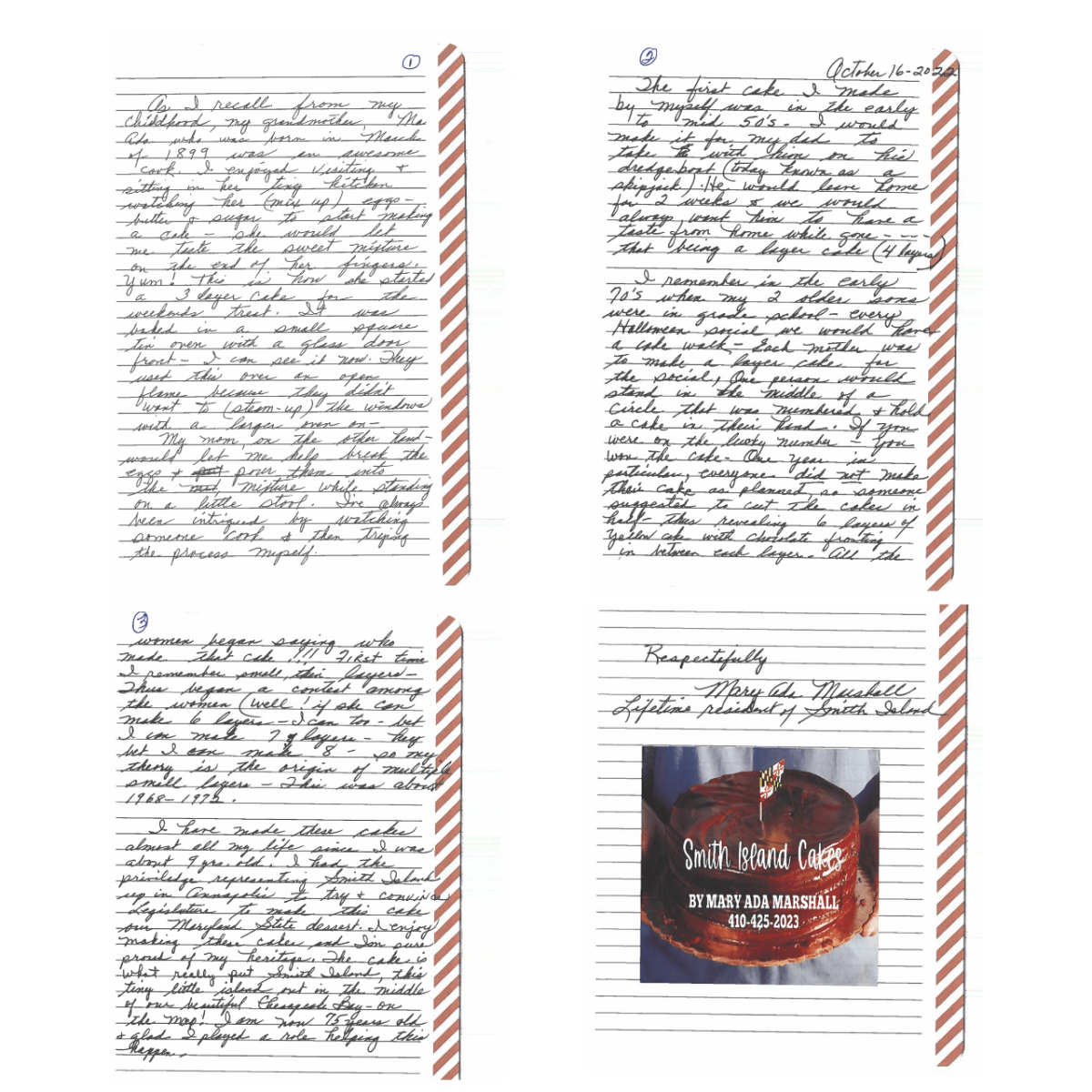
As I recall from my childhood, my grandmother Ma Ada who was born in March of 1899 was an awesome cook. I enjoyed visiting and sitting in her tiny kitchen watching her mix up eggs, butter and sugar to start making a cake. She would let me taste the sweet mixture on the end of her fingers. Yum! This is how she started a 3 layer cake for the weekends treat. It was baked in a small square tin oven with a glass door front. I can see it now. They used this oven on an open flame because they didn't want to steam up the windows with a larger oven on.
My mom on the other hand would let me help break the eggs and pour them into the wet mixture while standing on a little stool. I've always been intrigued by watching someone cook and then trying the process myself.
The first cake I made by myself was in the early to mid 50s. I would make it for my dad to take with him on his dredge boat (today known as a skipjack). He would leave home for 2 weeks so we would always want him to have a taste from home while gone, that being a layer cake (4 layers).
I remember in the early 70s when my 2 older sons were in grade school, every Halloween social we would have a cake walk. Each mother was to make a layer cake for the social. One person would stand in the middle of a circle that was numbered and hold a cake in their hand. If you were on the lucky number you won the cake. One year in particular, everyone did not make their cake as planned so someone suggested to cut the cakes in half, thus revealing 6 layers of yellow cake with chocolate frosting in between each layer. All the women began saying who made that cake. First time I remember small thin layers. Thus began a contest among the women. Well, if she can make 6 layers, I can too. But I can make 7 layers. They bet I can make 8. So my theory is the origin of multiple small layers. This was about 1968 to 1975.
I have made these cakes almost all my life since I was about 9 years old. I had the privilege of representing Smith Island up in Annapolis to try and convince the Legislature to make this cake our Maryland State dessert. I enjoy making these cakes and I'm sure proud of my heritage. The cake is what really put Smith Island, this tiny little island out in the middle of our beautiful Chesapeake Bay, on the map. I am now 75 years old and glad I played a role in helping this happen.
Respectfully, Mary Ada Marshall Lifetime resident of Smith Island
Janice Marshall's family story goes back even further. Her great grandmother Rachel was baking cakes on Smith Island in the 1800s, long before modern stoves existed.
Letter from Janice Marshall | October 19, 2022
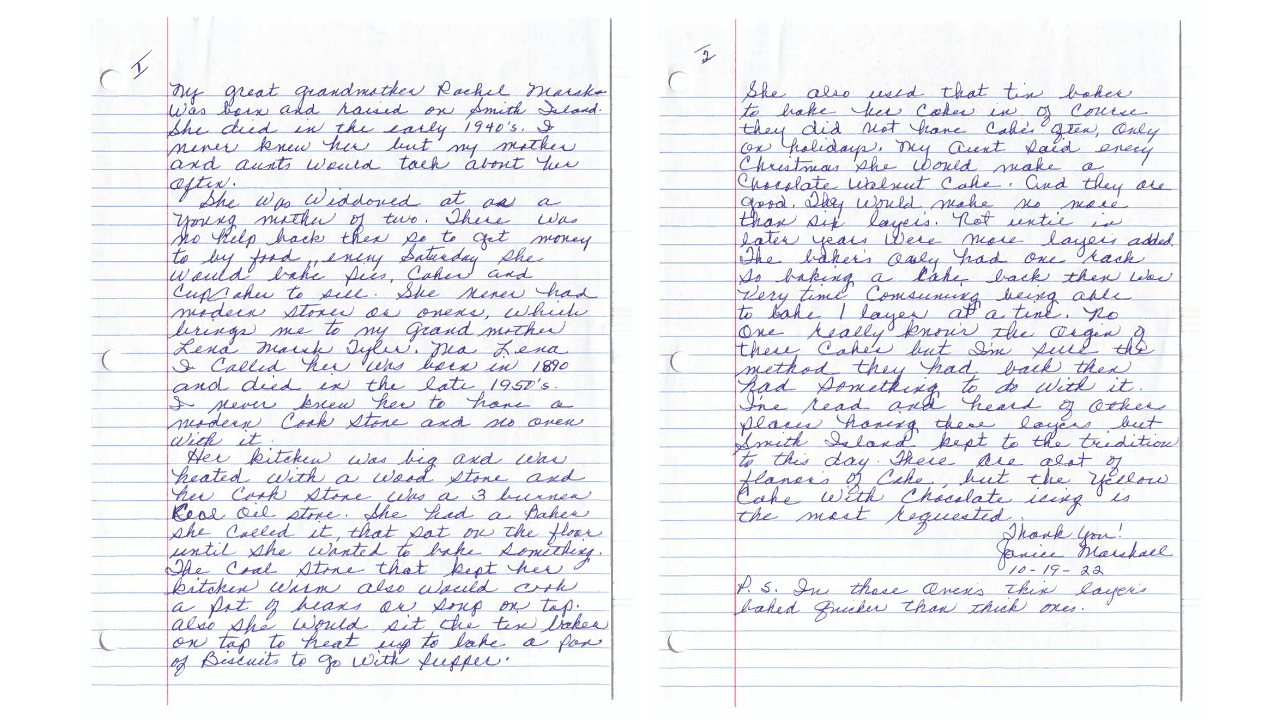
My great grandmother Rachel Marsh was born and raised on Smith Island. She died in the early 1940s. I never knew her but my mother and aunts would talk about her often.
She was widowed at a young mother of two. There was no help back then so to get money to buy food, every Saturday she would bake pies, cakes and cupcakes to sell. She never had modern stoves or ovens, which brings me to my grandmother Lena Marsh Tyler. Nea Lena I called her, was born in 1890 and died in the late 1950s. I never knew her to have a modern cook stove and no oven with it.
Her kitchen was big and was heated with a wood stove and her cook stove was a 3 burner kerosene oil stove. She had a baker she called it, that sat on the floor until she wanted to bake something. The coal stove that kept her kitchen warm also would cook a pot of beans or soup on top. Also she would sit the tin baker on top to heat up to bake a pan of biscuits to go with supper.
She also used that tin baker to bake her cakes in. Of course they did not have cakes often, only on holidays. My aunt said every Christmas she would make a chocolate walnut cake. And they are good. They would make no more than six layers. Not until later years were more layers added. The bakers only had one rack so baking a cake back then was very time consuming being able to bake one layer at a time. No one really knows the origin of these cakes but I'm sure the method they had back then had something to do with it. I've read and heard of other places having these layers but Smith Island kept to the tradition to this day. There are a lot of flavors of cake but the yellow cake with chocolate icing is the most requested.
Thank you! Janice Marshall 10-19-22
P.S. In those ovens thin layers baked quicker than thick ones.
The next time you sit down with a slice of Smith Island Cake, count the layers. Each thin one represents something. A tin oven on a kerosene stove. A father heading out on a skipjack for two weeks. A Halloween social where someone cut a cake in half and changed everything.
This is not just Maryland's official state dessert. It is Smith Island's story. Told one layer at a time.
Modal title